Showing posts with label boomdiggy. Show all posts

Tuesday, June 25, 2013

CSI Pre-Algebra is Now Live!

Coming to an Electronic Teacher Resource
Store Near You!
CSI: Pre-Algebra has arrived. I've been asked by a number of lower grades teacher about making something for them. It is nearly ready to go so be prepared to defend the world against the world conquering device! So here it is!

Each unit can be purchased separately or you could save some cash and buy the whole eBook! 

For those unfamilar with my CSI puzzles, I take a unit of math material, select a different world region and create a fictional crime spree with clues (aligned to the Common Core, hurray!)

HERE IT IS: The CSI Pre-Algebra eBook
You can now get the Interactive & Customizable Version of CSI Pre-Algebra @ NextLesson.org

When it is all together, here's what you will find.

Unit 1: Order of Operations & Expressions (South America) 
Unit 2: Factors, Primes & Multiples (Middle East) 
Unit 3: Equations & Inequalities (Europe)
Unit 4: Decimals (Oceania)
Unit 5: Exponents, Roots & Scientific Notation (East Asia)
Unit 6: Fractions (Central America)
Unit 7: Ratio, Proportion & Percent (Africa)
Unit 8: Coordinate Plane (Antarctica)
Unit 9: Data Analysis & Probability (North America)

Tuesday, March 12, 2013

Carbon Footprint -- Environment Focused STEM Project

Bring an authentic environment-based 21st Century Math Project  to your Algebra classroom with Multi-step inequalities! Help student understand why we are still getting blizzards in the spring!

Suggested Grade Level: 7-12 (Algebra 1, skills)
Math Concepts: Multi-step Inequalities, Unit Conversion, Multiple Representations
Interdisciplinary Connections: Travel, Local Food, Carbon Emissions, Environmental Science
Teaching Duration: 2-4 Days (can be modified)
Cost: $6 for a 27 Page PDF (1 project, 2 assignment and handouts) 
PDF Version: Carbon Footprint @ TPT

The Product: Students complete an Amazing Race style challenge where they must finish a cross country trip and select choices that are within their carbon footprint, financial and time budgets!

Hey kid, all administrators drive Hummers.
It's required! No, I don't know about its
carbon footprint! Oh, really?!
While you may not raise sufficient capital to put a fleet of windmills in your school parking lot, you can still teaching some environmentally conscious mathematics! 

In the 2000s, the Kyoto Protocol aimed to set goals for an individuals carbon emissions by country. The United States decided this wasn't something they wanted to be part of. When doing some inequality mathematics, you can quickly see how challenging this would be for an average, I like to drive my own car 30 miles a day and eat a hamburger for dinner type of person. Although students may not make an drastic life changes (maybe they will) it will at least be an assignment that ensures they at least see a link!

Although students will learn elements of carbon emissions, the lessons focus on creating and using multi-step inequalities to model situations and make decisions. With an increasing focus on environmental issues this explores a view on a science topic that students may never have been exposed to before.

You mean like I have a theoretical
footprint because I eat Hot Cheetos?

-- Planes, Trains & Automobiles.  Students will write multistep inequalities to determine if individual’s daily transportation needs exceeds the CO2 emissions totals described in the Kyoto Protocol.

--  Well-Traveled Food. Students will use the Food Footprint Chart to complete this assignment which provides a look at food production and transportation emissions and the difference between local and traditional food sources.

which leads to the project --

-- the Amazing [more environmentally conscious] Race. Using a CO2 Emissions Per Activity chart, student will make travel and food choices on a cross country trip.


This is all great and everything,
but what could be do to take action
in our local community?
It doesn't take much looking to find this issue in the news in one shape or form and kids like travel and food maybe it's a great match for you!

EXTENSION: Student could certainly track their own Footprint over a 24 hour period. Other ideas could be things like a recycling club, a push for automated light switches, a student presentation to the school. 

This 21st Century Math Project is endorsed by Polar Bears everywhere! Well that's an exaggeration, I've only asked the two at our zoo and I'm not sure if that's exactly a representative random sample since they were born in captivity.

Wednesday, February 20, 2013

Toothpick Bridge -- STEM Project


For another smooth integration for your science and math curriculum, this 21st Century Math Project intends to bridge that gap. Hahaha get it? Bridge the gap! And it's a project about Bridges! You get it? Contest style, students will try to build the strongest bridge as light as possible. 

Name: Toothpick Bridge
Take that toothpick out of your mouth and build a bridge
with it!
Suggested Grade Level: 7-12 (Geometry skills)
Math Concepts: Measurement, Shapes, Symmetry
Interdisciplinary Connections: Engineering, Science, Architecture
Teaching Duration: 4-5 Days (can be modified)
Cost: $5 for a 12 Page PDF (1 project, 1 assignment and handouts) 

The Product: Students create presentations regarding their design process and the links to geometry. Oh, and of course an awesome contest.

What's all that noise?! Student
Engagement?!! Bah!!


One of my favorite high school memories was doing this type of project in Physics. I seemed to have a glue problem -- meaning that I used WAY too much glue. I still contend that the bridge didn't break, but kind of folded. So while I certainly did not invent this project, I thought the applications to geometry were really strong. Each type of design has elements of geometry built in.

Break stuff? I'm in.


In this project, teams of up to three students will construct a bridge out of only toothpicks. This toothpick bridge must be able to hold a predetermined load without failing. Teams will research the style of bridges, create a three-view diagram of a bridge, build it, test it and complete a presentation about the project and its connection to geometry and the design process. The ultimate goal is to build a bridge that is strong, but is light as possible. The bridge with the greatest ratio of load weight to bridge weight will win the contest.

I limit students to only using flat toothpicks and Elmer's glue. I find the simpler, the easier. 

As far as testing these bridges go some people like to stack free weights. In high school, I recall this falling on someone's foot so I didn't do this. I've seen a string connecting a bucket to a 2x4, but that would require having a drill press handy. I've chosen to write the project using a good ol' fashion bungee cord and a large bucket (think a 5 gallon paint can). I like to write these in a way anyone can pull them off with minimal complications. 


Who needs a consultation?
In the bucket, I fill it with water and use a household scale to determine the winner. Of course, you'll need to borrow a gram scale to measure the weight of the bridge. While it is a little bit of hunting, the payoff promises to be a blast and one that high school students will not forget.


EXTENSION: You could attach a budget to this project! Maybe charging for toothpicks and cups of glue. Maybe charge for an engineering consultation. The possibilities are endless. 

It seems around every corner there's a new STEM school popping up and 21st Century Math Projects can help! If this is interesting I've also integrated projects for an Egg Drop, Box Car Derby and Solar Oven. 

Wednesday, January 16, 2013

Nelson Mandela -- Systems of Equations Person Puzzle


Back with more, we have the next 21st Century Math Project Algebra 1 puzzle the one and only, freedom fighter -- Nelson Mandela! 


Eliminate Systems... while learning about eliminating systems!
Name: Person Puzzle -- Nelson Mandela
Suggested Grade Level: 7-12 (Algebra, Prealgebra skills)
Teaching Duration: 10-30 minutes
Cost: $0.75 for a 2 Page PDF (1 assignments and answer key) 


Although seen by some as a controversial figure, nobody can deny the life story and work of one, Nelson Mandela. A beloved figure by many, Mandela is an individual that has certainly changed the world and now... he's in a Person Puzzle!!!
Hello, I'm a certified ninja
apartheid destroyer! And now
I'm a Person Puzzle. Learn about me

And do some systems of equations practice! It would work great in a middle school or high school class!


Saturday, November 3, 2012

Box Car Derby -- STEM Project

I feel the need, the need for practical equation solving
Hands-on math takes center stage in this 21st Century Math Project. Implementing STEM style project-based learning is the focus in this middle and high school math project. Along with designing, building and constructing a cardboard car students will use algebra skills to solve basic physics problems, engage in reflective writing and use data to support their decisions.

Name: Box Car Derby
Suggested Grade Level: 7-12 (Algebra I math skills)
Math Concepts: Manipulating & Calculating with Basic Physics Equations, Measurement
Interdisciplinary Connections: Science & Engineering
Teaching Duration: 3-5 Days (can be modified)
Cost: $5 for a 12 Page PDF (1 project and essentials, 1 assignment with answer key)
PDF Version: Box Car Derby @ TPT

The Product: A Box Car Derby Competition! With optional reflective presentation of results and Design Process.


What's that noise?
Transform an ordinary Pop-Tart box into a smooth riding street racer! Students will get uber-enaged in this 21st Century Math Project in their attempt to be fastest racer. This serves as Middle or High School math project and can be a great collaboration between math and science.

The first time I used this project was in my 9th Grade Algebra 1 Class in a collaboration with the Physical Science teacher. Students submitted designs, “purchased” items for our store with their budget, built and test to perfection. It’s safe to say, this project was a huge success. The most difficult aspect was getting a strong wheel and axle combination. By far the best combo that worked were straight straws (with no bendy neck) and tealight candles. You can get a billion of them for $10 at Amazon.


Playing with Fruit Loops boxes.
Is that in the Common Core?
While there is not precise Common Core standard for Fruit Loops boxes, these are a few high school standards that fit this project:

Algebra:
--Seeing Structure in Expressions
• Interpret the structure of expressions
-- Reasoning with Equations and Inequalities
• Understand solving equations as a process of reasoning and explain the reasoning
• Solve equations and inequalities in one variable
• Rearrange formulas to highlight a quantity of interest, using the same reasoning as in solving equations.
Statistics:
-- Interpreting Categorical and Quantitative Data
• Summarize, represent, and interpret data of two categorical and quantitative variables
-- Making Inferences and Justifying Conclusions
• Make inferences and justify conclusions from sample surveys, experiments and observational studies


Can I take my Ratchet-Mobile home with me?
Let the games begin! After the Box Car Derby, it is in the teacher’s discretion to turn it into a Demolition Derby. While it sounds appeal, you’re soft (and hard) children will likely want to keep their car after their significant bonding period. It’s like a birth.

EXTENSION: While these cars are small enough to carry around, making a person-sized derby car sure sounds like a fun idea. Probably for extra credit 

21st Century Math Projects on the fast track to practical equation solving! If during the course of reading this blog you have went to your cupboard to see if you have a nearly empty Pop-Tart box, raise your hands.

Monday, October 22, 2012

Making the Band -- High School Math Project

Math, Math, Baby

After a couple years of teaching systems and linear equations, I knew I needed to add some 21st Century Math Project kick. Fortunately, systems are a topic that lends itself well toward practical application. Students will make choices that will affect the launch of their album. Layered with literacy practice, students will make choices within a budget that will affect the cost and revenue of their album. The project builds on itself. After a day of decisions, the next day those decisions may pay off...it depends on the linear equation.

Name: Making the Band
Suggested Grade Level: 7-12 (Algebra I and Algebra II math skills)
Math Concepts: Creating & Using Linear Equations, Systems of Equations, Multiple Representations
Interdisciplinary Connections: Music, Business
Teaching Duration: 3-5 Days (can be modified)
Cost: $6 for a 12 Page PDF (1 project with 3 components) 

The Product: A cost-revenue analysis and determination of a break-even point for a student-created mathematical album where the results can culminate in a class presentation. Performing their song is optional.

This is meant to be a blend of the reality television craze with systems of equations. I've never had a student not engaged in this project. Competition never has been higher. Students attempt to break-even with their record and become profitable in the least amount of time.

Students don't want choice! They want
to do exactly what I tell them to do!
This 21st Century Math Project might work as a Middle or High School math project depending on if you students have experience with modeling linear equations and solving basic systems. Here is the challenge math teachers… student choice and chance is at the fulcrum of this exercise so it is likely that no two students will have the same results. Thus, there is no answer key. The genesis of this project was from my childhood enjoyment from Choose Your Own Adventure Books.

In terms of structure, this assignment will likely be different than anything a student has done before. A teacher will likely need to be very clear with directions and possibly guide students through a hypothetical example before each part of the assignment.

Greeeaaat... another write a song assignment.
Oh wait, you want me to actually do math
and calculate stuff? Okay that might actually
help me on the ACT.
The assignment will start with students coming up with the name of a mathematical song and sketch an album cover (I give this as homework the night before). Based on the awesomeness, of their song name and album, you will give students different start-up costs. Awesome songs cost less to get started. Kind-a-sucky songs cost more.

In the “Financial Document”, students will then make a number of decisions based on descriptions and determine which are monthly and one-time start-up costs and with a little work they will have a linear cost equation.

In “Did They Pay Off”, get the dice ready because chance will play a role. Based on the decisions the day before, there is a revenue benefit but this varies greatly on luck. Wiser decisions will likely lead to higher revenues. Students will use this revenue equation to determine when they will break-even on their project.

This might push me to actually record
my album -- Math Swagg. Aight, that's
actually kinda dope. 
I have included an option “Change of Plans” assignment, because of course things don’t always turn out according to plan. Students will have a random multiplier applied to their slope and will rework their equations to find a new break-even point.

To conclude the project, I have done this differently. I have simply ended it after the assignment was complete and on another occasion I added a presentation component. Student definitely enjoyed presenting their information. If I were to do it again I would have small groups present to each other, nominate a top presenter and then have them present to the whole class. Presenting could also be offered as extra credit.

EXTENSION: Taking this another step could be to encourage your students to actually record the music (Audacity is great and free). Perhaps have a class album.  

21st Century Math Projects can be funky too. Extra funky. Many teachers have students write and perform math songs, and often this might be fun, but not very mathematically rigorous. Why not actually make them do some relevant math too?! 

Thursday, October 11, 2012

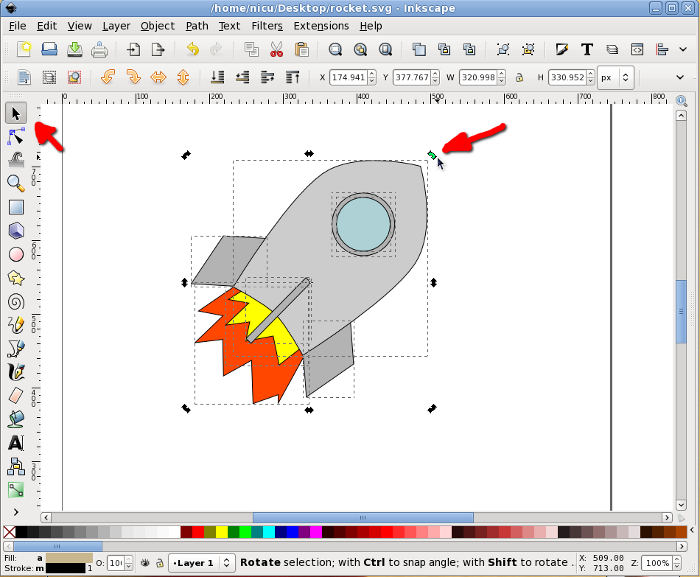
Inkscape -- Cool Software Spotlight

Drawing for the artistically skill-less
Can you not color inside the lines? Does pottery melt in your fingertips? Does the word watercolor make your skin crawl? If you answer yes to any of these questions you are just like Mr. 21st Century Math Projects. The Inkscape is for you and may help you create your next high school math project! Well maybe not, but… maybe. If you have ever toyed with a Photoshop program, Inkscape may be intuitive enough for you to pick up. It’s a free open-source software that creates vector art.

As far as I understand it, there are two main image types: rasters and vectors. Most people have experience drawing with rasters. This is like doodling on a digital picture of your ex-boyfriend's face. “Cutting” you out of a picture and putting you in front of the Grand Canyon although you’ve never been there. The major difference is that when you “stretch” raster images the quality of the picture will deteriorate and look blurry mess. Vector art (mathematics!) is created with lines, shapes and data so when you stretch it, everything is proportionally increased. This allows you to make things as big or as small as you like!

Creating a logo, no problem. You draw it once and make it as large or small you like.

Blast off!
So how does this help with 21st Century Math Projects? Pretty much everything in my projects I draw. From the silly faces to application problems to graphs is done on Inkscape. You don’t need to be a professional artist, but you will need to devote some time to learning how to get around the software (although anything that you’ll likely need is pretty easy to do). There are a fair amount of shortcut tricks using some previously created free vector images that can save you some time such as www.openclipart.org which I will share on the blog later.

Want to become Inkscape buddies? Holler in the comments. If you want some tips or images, let me know. 

Tuesday, October 9, 2012

Facebook, Twitter & the Arab Spring -- International STEM Project

Join the Revolution!


Facebook, Twitter, YouTube and Globalization in a high school math project? Toss in a scoop of inquiry and that's what you have here. Patterns, algebra and functions get a facelift to the 21st century in this integrated international math project. Through mathematical modeling and regression, students are able to use authentic real world data to consider its real world implications. This project would fit well in an Algebra 1 class (with guidance) or an Algebra II / Precalculus class. 

Name: Facebook, Twitter & the Arab Spring
Suggested Grade Level: 7-12 (Algebra I and Algebra II math skills)
Math Concepts: Creating Functions from Patterns, Rate of Change, Creating and Applying Regression Functions
Interdisciplinary Connections: World Studies, Globalization, Social Media, Current Events
Teaching Duration: 4-5 Days (can be modified)
Cost: $5 for a 22 Page PDF (2 assignments, 1 project and Answer Key) 

The Product: An interactive web-based timeline (or hand drawn if no computer access) which details Twitter data during the Egyptian Revolution along with the timeline of historical events.

What is more relevant than a social media revolution that topples governments one by one? As governments fell, I kept asking myself “Did Facebook and Twitter cause this revolution?” While this is a question I’m sure professors are wrestling with, it certainly can be adapted to my high school math class.

Does this have something to do
with Aladdin?
The challenge is finding appropriate mathematically rigorous content that matches the cool project idea. In this 21st Century Math Project might find its way into a Middle or High School classroom depending on the skills and abilities of your young people. Do not be intimidated math teachers! Learning a little about the Arab Spring is probably good for you too, but I have built the mathematics in such a way that while the task is authentic, it’s independent. In other words that math is still very mathy.

Now the final project is a challenge and probably unlike any math assignment the student has ever done before. Compare data to narrative history? What kind of crazy person would ever think about this? In order to build up these skills, I created a pair of equally social media friendly assignments that are included in this project. I have written introductions to help cement the authenticity of the assignment and provide necessary background information (for you and them)


You mean, like, countries were, like,
protesting for their freedom on Twitter?
I gotta know some more about this.
"Facebook Friend Challenge" -- which focuses on finding patterns, comparing rates of change and projecting into the future.

and "Kony 2012" -- this focuses on the mathematics behind a viral video. Providing a little background on the Kony 2012 video can give your math classroom an international, multi-disciplinary flair. In this assignment, students will analyze a pattern, consider the rates of change, plot the function and make predictions about the future. 

And this leads to the granddaddy: "Did Egypt Tweet Its Way to Freedom" -- focuses on a data analysis of Twitter tweets surrounding the Egyptian Revolution inside the 2011 world shaping Arab Spring. Students will analyze patterns, rates of change and consider the inquiry question. "Did Twitter play a role in the liberation of Egypt during the Arab Spring?" In this assignment students will compare mathematical rates of change with real world rates of change in international conflict. Students will produce a timeline project that provides their stance on the inquiry question and uses mathematical evidence as support.


They won't care about the Middle East.
They can't even find it on a map!
Honestly, of all the projects I wanted to take on this past summer, I really wanted this one to work and I was happy to find the right mix of skills to make it mathematically rigorous enough.

The Copy Machine Diva Teacher points out the legitimate concern. What if my students don’t know what the Arab Spring is? Much less why it’s relevant. My response is two-fold… 1) what in the world have they been taught the last two year? 2) this is a great opportunity for a cross curriculum collaboration. If reaching out to other teachers isn’t in your wheelhouse (give it a try sometime, it’s fun!), I have never been shy about teaching a little social studies, science or health to make my math problem more relevant and authentic. If you are commitment to being a 21st century teacher, I think this is necessary and an area we all can grow. And trust me I’m growing too. Fortunately I have worked in two different schools where I HAD to grow in this way.

EXTENSION: Taking on an academic inquiry question like this lends itself well to connecting with a local university. Professors may be willing to step in for a guest round table or may be willing to watch your best presentation.

Join the 21st Century Math Projects revolution! Authentic. Engaging. Relevant. Sounds like the makings of a solid Justin Bieber song. 

Wolfram Alpha -- Cool Website Spotlight


There's no better example of a  21st Century Math Project than an awesome site, the mathematically famous Wolfram Alpha. Yes, sure Wolfram Alpha will do your class’s homework for them, but the reality is that that only emphasizes the need for higher order thinking. Computers can solve linear equations, but as of today they still struggle with word problem and application. One day. One day.

Until then the human brain has value!
On its way to growing a real brain!

Well okay, not really. When I decide to create a new middle or high school project, Wolfram Alpha is one of my first stops. In particular when I’m attempting to use global data, I’m able to compare countries very quickly. This is particularly helpful when trying to find interesting mathematical problems and it turns into my own personal inquiry project. For instance if I’m trying to build an assign around GDP and exponential functions, if I choose two countries that do not intersect, it makes for a less mathematically interesting exercise. Of course using one problem built around this case, is worthwhile, but if I built the entire assignment where nothing intersects, it’s weird and useless.

Using Wolfram Alpha in cooperation with one of many Online Regression calculators helps rounds ideas into more precise problems.

There is a pay subscription that would make using this tool infinitely more useful, but I have yet to use it. For anyone with a familiar with vector graphics (like the open source Inkscape; more on this in another post) there is a way to get vector exports of graphs on Wolfram Alpha. In order to make it more usuable in an assignment, you may need to tweak the graphic so using a vector program works well.

Nonetheless, Wolfram Alpha is super duper at helping with answer keys!

If you aren’t using Wolfram Alpha, check it out! 
Ninth, Tenth, Eleventh, Twelfth - NextLesson.org Ninth, Tenth, Eleventh, Twelfth - TeachersPayTeachers.com